
%402x.svg)
Steal This Structure Until You Learn to Write
Steal This Structure Until You Learn to Write. Or, without structure, you will not learn to write! I was 11 years old and known for talking
%402x%20(medium-dark).svg)
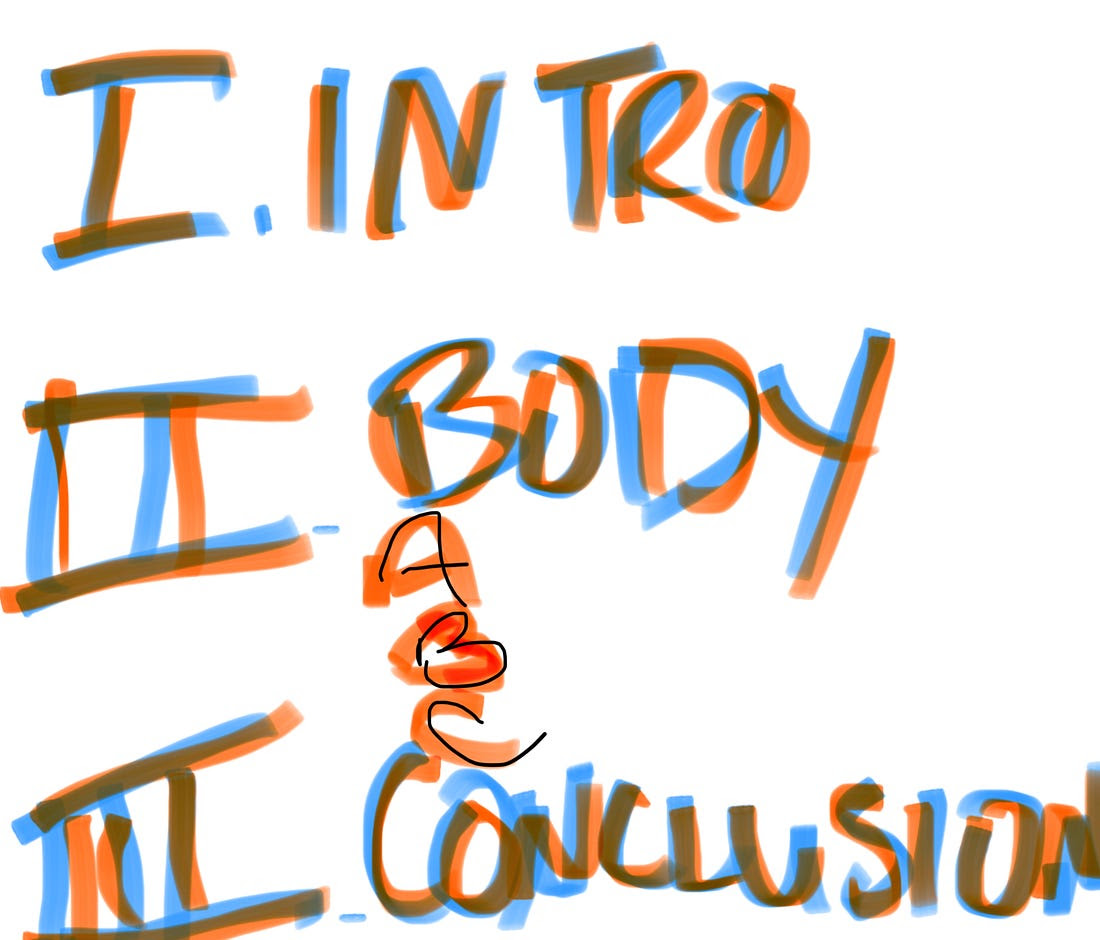
Steal This Structure Until You Learn to Write. Or, without structure, you will not learn to write! I was 11 years old and known for talking too much and exasperating my teachers. I was not known for academics, except my teachers would say, “He has so much potential, but…”
But I had at least one great teacher. Mrs. Lindley. She was lovely. Not young and pretty like the kind a kid has a crush on. Her soul was lovely, like the kind of person who makes you think Jesus is real. If, like many other teachers, she did not like me, I never would have known it.
I felt liked.
Which is why in her reading class I put my mind to it when she taught us the classic essay.
I remember looking at it like a hard puzzle that I would normally have given up on. On any other given Tuesday I might have shrugged and just started writing whatever.
Who knows how that would have turned out.
But I wanted to please that sweet angel who believed in me, so I can imagine my face all screwed up in concentration and then relaxing into whatever revelation looks like.
I got it.
It made sense. All you gotta do is have an idea. A thesis statement.
Then you gotta write it down and support it in an introduction, like so…introducing three sub points.
These points will be your three body paragraphs.
Each paragraph will start with a sentence that is the main point.
Followed by three sentences that support it.
Followed by a summary sentence before going on to the next paragraph.
Once the three body paragraphs are written like that, then comes the concluding paragraph, wrapping it up and restating the thesis.
I wish I could remember what I wrote about. But I remember the way Mrs. Lindley reacted.
It was that moment that all teachers long for. I imagine now she was having an experience where she was suddenly certain that her life had not been in vain. I imagine that she’d made a vow as a young woman that if she “could reach just one dull student with the light, it would have been worth all the suffering of being a junior high teacher.”
All I saw at the time was that I had made her happy. And that made me happy.
It may very well be why I write today for a living.
(Oh, wow. Now that I think of it, there were two more teachers. One was Mrs. Camp, who was my 5th grade teacher. I know she struggled with me, but she saw me as a poet and even gave me a nicely bound book of blank pages so that I would write more poems. And then there was my high school English teacher, Mrs. McElroy, who said, “You know Jeff. You could be a writer.” I did not believe her then, but I remembered it later when I became one. Thank a teacher if one ever made a difference.)
You might be thinking: Jeff, you don’t even write in the classic essay style.
I know, but we’re not talking about me. We’re talking about you. As I coach more and more Christian writers, they have passion, they have a solid message, they have discipline, but they struggle with structure.
Here’s why it matters. If you don’t have any kind of structure, the reader will get lost. Your charming sentences aren’t enough if the reader doesn’t get why you wrote them.
I didn’t write this in the classic essay structure, but I do have structure.
- I told you a story that illustrates my point. That’s a hook.
- I told you my point.
- Yes, I took a side trip about the importance of great teachers, but it’s a side trip and any trip is made more interesting by a side trip. If I were preaching I might step out from behind the pulpit to deliver my side trip, and then I would step back up to resume my main trip.
- Then I brought the point of structure into focus.
- Now I’m further illustrating it by showing the scaffolding of this article.
- Next I will show you a rewrite of the same article in a classic essay form, just for fun.
- Then I will give you some steps to try it on your own.
- Then I will make a pitch for my Christian Writers’ Community that you can join by upgrading to the basic paid subscription where you can get coaching, feedback, and encouragement from our editing team and me at Indie Christian Book, and also from other participants like yourself.
So where were we? Right, I just promised to rewrite this essay in classic form. Here goes.
The Power of Structure
Ever since I was an eleven year old in Mrs. Lindley’s sixth grade reading class, I have known the power of the classic essay structure. That wonderful lady was the kind of teacher who got misty eyed and praised God through the hole in the heavens that had just opened up when she saw I had understood the format and used it perfectly in that day’s assignment. The classic essay comes in three main parts: the introduction, the body, and the conclusion. Learning to write in the classic essay format will structure, not only your essay and its argument, but also your mind, as it creates guardrails for clear thinking about the topic at hand.
The first part of the classic essay is the introduction. The introduction is the most important piece of the structure. Though it sits at the top, one might consider it the foundation of the essay. The introduction revolves around the main point, which I will call the thesis. This is the sentence that is also the point to be argued in the essay. In mine today, the thesis is that every piece of writing should have structure, and the classic essay structure is one of the best, so here is how to do it. Once you have the thesis, you can use the introduction to introduce it, support it, and forecast the body paragraphs, such as I did in my intro about the intro, body, and conclusion.
The beef of the essay is the body. In the classic structure we were taught growing up that the body will have three main points in three paragraphs. Each point will be introduced in the first sentence so that if a skimmer wanted to get the gist of the essay, she could simply read the first sentences of each paragraph. But to get a deeper understanding, she will need to read the whole paragraph, because there will be important subpoints and illustrations that will further clarify things. The body paragraphs will be the opening main sentence, followed by three supporting sentences, followed by some sort of restatement of the first sentence.
The final piece of the classic essay is a strong conclusion. This is going to be at least a summary of the thesis and the three main body points followed often by a call to action. The summary is necessary, because it reinforces the information in the essay. Without a good summary, the reader won’t have closure. It’s like a song that just ends without resolving back to the tonic. If you are a musician, you will know how unsatisfying that is. A good call to action is what can make the whole essay worth reading. It might change someone’s life. So don’t end your essay without a conclusion.
Structure is important when you’re writing. If your idea is worthy of being discovered, then it’s worthy of being laid out in a way that the reader’s mind is wired to process and learn. Do you want to change lives? Then you need your writing to be digestible and sensible. If it is going to be digestible and sensible, then you must have structure, and the classic essay structure is one of the easiest to learn.
So there it is. Keep reading if you want an exercise.
If writing with structure is important, making an outline is doubly important and it will help immensely. Here’s an outline of what I just did.
Title: The Power of Structure
I. Introduction
Hook
- Mrs. Lindley’s sixth-grade reading class
- The moment structure finally clicked
- Teacher’s excitement at seeing understanding dawn
Bridge
- Structure is powerful because it organizes not only writing but thinking
Thesis
- The classic essay structure is one of the best frameworks for beginning writers, because it provides clear organization through an introduction, body, and conclusion.
Forecast
- Introduction
- Body
- Conclusion
II. Body Paragraph One: The Introduction
Topic Sentence
- The introduction is the most important part of the essay.
Support
- It revolves around the thesis.
- The thesis states the main point to be argued.
- The introduction previews the main points that will follow.
Closing Sentence
- A strong introduction gives both writer and reader a roadmap for the rest of the essay.
III. Body Paragraph Two: The Body
Topic Sentence
- The body contains the main argument of the essay.
Support
- The classic structure uses three main points.
- Each paragraph begins with a clear topic sentence.
- Supporting details, examples, and illustrations develop the point.
Closing Sentence
- Well-structured body paragraphs help readers understand and remember the argument.
IV. Body Paragraph Three: The Conclusion
Topic Sentence
- A strong conclusion brings the essay to a satisfying close.
Support
- It summarizes the thesis.
- It reviews the major points.
- It often includes a call to action.
Closing Sentence
- Without a conclusion, an essay feels unfinished and less persuasive.
V. Conclusion
Restatement of Thesis
- Structure is essential for effective writing.
Summary
- Introduction provides direction.
- Body develops the argument.
- Conclusion reinforces and applies the message.
Call to Action
- If you want your ideas to change lives, learn and practice the classic essay structure.
What do you want to write about?
Don’t start writing yet.
First, make the outline.
Then write the classic essay.
Here’s a blank one.
Title: __________________________
- Introduction
Hook
Bridge
Thesis
Forecast
- Point 1: __________________________
- Point 2: __________________________
- Point 3: __________________________
- Body Paragraph One
Topic Sentence
Support
Closing Sentence
III. Body Paragraph Two
Topic Sentence
Support
Closing Sentence
- Body Paragraph Three
Topic Sentence
Support
Closing Sentence
- Conclusion
Restate Thesis
Summarize Main Points
Call to Action
Fill in the blanks.
Then write.
Mrs. Lindley would be proud.
If you can fill this in logically, then you can write the essay that will make sense to the reader.
Shameless pitch: We have a grand time every Tuesday talking about this kind of thing from 11-1 CST. We have training and feedback for two hours of come-and-go workshopping.
To join us, all you have to do is upgrade to paid.
I can’t bear to hide any of my writing behind a paywall. I’m much too vain!
But upgrading gets you into the community where we discuss all things writing and publishing.
For instance, today, we’ll have a couple of guest speakers from KingdomCommunicator.com in to talk to us about building a platform for getting our message out through, not only books, but also speeches, podcasts, and other media. After that, we’ll do feedback on participants’ writing. Some of us are writing books; some of us are writing articles. All of us are called by God to spread a message.
You can even come today. Simply upgrade and we’ll be in touch with the link.
Jeff
We've got the answers for your questions
Publishing can feel overwhelming, but you’re not alone. Here are answers to common questions—if you need more help, just reach out!
At Indie Christian Book, our difference is rooted in two core commitments:
Excellence in Editing: We take exceptional pride in our thorough editing process. Your manuscript undergoes multiple stages of careful refinement—structural, content, line, and proofreading—ensuring your book reaches readers in its most polished and powerful form. We believe that meticulous editing honors both your message and your readers.
Personalized Guidance: We recognize that each author's journey is unique. Rather than applying a one-size-fits-all approach, we partner closely with you to understand the specific purpose God has placed on your heart. Your book receives individualized attention tailored to your particular vision, audience, and ministry goals.
This combination of editorial excellence and personalized care ensures that your published work truly reflects both your voice and God's purpose for your writing.
The timeline varies based on your book’s needs, but most projects take 4-6 months from manuscript to publication.
Yes! We offer platform development, book launch strategy, and promotional support.
Each project is unique—contact us for a custom quote tailored to your publishing needs.
We publish a wide range of faith-based books, including:
- Teaching Materials
- Memoirs & Biographies
- Devotionals
- Biblical Studies
- Ministry Resources
- Christian Living