
%402x.svg)
Shakespeare’s Prospero and Why Going Deep Doesn’t Mean Abandoning Your Life
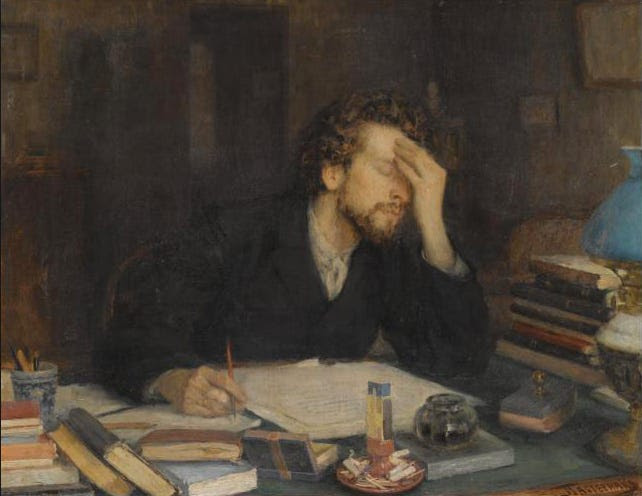
Shakespeare’s Prospero and Why Going Deep Doesn’t Mean Abandoning Your Life. The Lie We Absorbed. We have all seen the tortured artist.
%402x%20(medium-dark).svg)
Shakespeare’s Prospero and Why Going Deep Doesn’t Mean Abandoning Your Life
The Lie We Absorbed
We have all seen the tortured artist. The trope has seeped into our souls so that at least some of us struggle to see ourselves as real artists if we’re not reckless, damaged, and on a path to die young.
At the very least, we need to be bad at life. Good at art, but bad at life. And relationships. Don’t forget relationships.
The world needs to know that we have sacrificed for them. For the art, but really for them, who will love us for the art.
So romantic.
And dumb. And wrong.
But common:
Sylvia Plath, Ernest Hemingway, Virginia Woolf, Edgar Allan Poe, Hunter S. Thompson, David Foster Wallace, John Kennedy Toole, Arthur Rimbaud, Dylan Thomas, Hart Crane, Anne Sexton, Thomas Wolfe, Truman Capote, Franz Kafka, Fyodor Dostoevsky, Leo Tolstoy, Yukio Mishima, Cesare Pavese, Samuel Beckett, Jack Kerouac, Vincent van Gogh, Amedeo Modigliani, Jackson Pollock, Egon Schiele, Jean-Michel Basquiat, Mark Rothko, Edvard Munch, Caravaggio, Gustav Klimt, Jim Morrison, Kurt Cobain, Jimi Hendrix, Janis Joplin, Amy Winehouse, Layne Staley, Sid Vicious, Nick Drake, Jeff Buckley, Brian Jones, Keith Moon, Ian Curtis, Scott Weiland, Prince Rogers Nelson, Charlie Parker, Bill Evans, Chet Baker, Thelonious Monk, Modest Mussorgsky, Robert Schumann, Pyotr Ilyich Tchaikovsky, Heath Ledger, Marilyn Monroe, Philip Seymour Hoffman, River Phoenix, Montgomery Clift, Judy Garland.
This list is just the beginning.
This is our four-part Shakespeare series, and today I want to turn to him to consider this fallacy.
That is, the fallacy that you have to be tortured and messed up to go deep in your art.
The artist?
Prospero from The Tempest.
“But he’s a magician.” True, but even Prospero calls this “his art.”
Prospero is brilliant and talented. He goes deep, losing his whole life by letting the study of his art replace responsibility. He justifies this in the line:
“Me, poor man, my library was dukedom large enough.”
This is not devotion to learning, but substituting learning for life.
Prospero is the rightful Duke of Milan, a ruler who willingly retreats from public life to immerse himself in study. He hands the work of governing to his brother and withdraws into books, convinced that depth of knowledge can substitute for lived responsibility.
But it can’t.
He is betrayed, overthrown, and cast out to sea with his young daughter.
Years later, stranded on an island, Prospero has become extraordinarily powerful through his art. But the power he gains through isolation costs him nearly everything else.
I don’t think Shakespeare presents him as a misunderstood genius. He presents him as a man who mistakes inward mastery for a complete life.
Unlike many whose obsession with art is driven by status, Prospero seems to desire power. Not the power of dukedom, but real wizard power over nature.
For our purposes, it’s enough to see that he shirks responsibility in order to become great at his art, missing the point of life. This is a distortion.
Art should lend itself to life. It should be an inspiration toward life. It should represent life. Not replace it.
Furthermore, the extreme isolation causes Prospero to lose touch with lived reality.
I don’t think most of my readers here are in danger of losing touch with reality. But the real danger for responsible people is this: we will not consider ourselves artists if we don’t fit the mold of the obsessed and tortured soul.
But in the end, Prospero is not a warning against depth. He is a warning against staying gone.
Shakespeare does not punish Prospero for loving knowledge. He shows us what happens when knowledge replaces presence, when mastery replaces responsibility, when art becomes a substitute for life instead of a servant of it.
Prospero’s failure is not that he studies, but that he disappears.
And the remarkable thing is what Shakespeare does next.
He lets Prospero come back.
At the height of his power, when his art is finally complete, Prospero lays it down.
“I’ll break my staff,” he says.
“I’ll drown my book.”
This is not the renunciation of art. It is the refusal to let art dominate life.
Prospero returns to Milan. He resumes rule. He reenters relationship. He accepts limits again. The work that required isolation is finished, and now it must give way to responsibility.
That is maturity.
I’m not saying give up art, and hopefully neither is Shakespeare. I am saying you can balance life and art, and I know this because many people have done it.
Charles Ives is one of the greatest composers of the twentieth century. When most composers became college professors, nothing wrong with that, Ives sold insurance. This independence from needing to make immediate money from his music gave him the freedom to create something truly new.
There have always been artists who went deep without burning everything else down. Not shallow or safe artists, but serious ones. Geniuses we still consume.
J.R.R. Tolkien built one of the most imaginative worlds ever created while teaching, raising a family, and keeping ordinary obligations.
Jane Austen wrote with great insight into love, money, power, and self-deception while living a quiet, constrained life. No spectacle. No implosions.
Wendell Berry has spent a lifetime insisting, by both word and example, that art divorced from place, family, and responsibility eventually becomes thin. His work grows out of fidelity, not escape, and he is one of my very favorites.
These lives are not exceptions. They are evidence.
They show what Prospero had to relearn the hard way. That depth is not the enemy. Isolation is. That discipline is not the death of art. Disorder is. That greatness does not require abdication.
You and I do not have to ruin our lives to justify our work. We don’t have to fail at love, responsibility, or faithfulness to earn the right to be taken seriously. Art is not a substitute for life because it is meant to serve it.
And you can think of yourself as an artist even if you have your life together, get the kitchen cleaned, the kids fed, and make it to the PTO meeting on time.
The goal is not escape.
A Gentle Rule for Writers
Before you withdraw to work, and again before you publish, ask a few simple questions.
Does this work return me to life, or excuse me from it?
Does my depth serve love, or replace it?
Am I using the work to avoid responsibility, or to reenter it more faithfully?
You might even experiment with this: close the open loops of your day, then sit down to write. See whether clarity, rather than chaos, doesn’t make room for deeper work.
Jeff B. Miller
We've got the answers for your questions
Publishing can feel overwhelming, but you’re not alone. Here are answers to common questions—if you need more help, just reach out!
At Indie Christian Book, our difference is rooted in two core commitments:
Excellence in Editing: We take exceptional pride in our thorough editing process. Your manuscript undergoes multiple stages of careful refinement—structural, content, line, and proofreading—ensuring your book reaches readers in its most polished and powerful form. We believe that meticulous editing honors both your message and your readers.
Personalized Guidance: We recognize that each author's journey is unique. Rather than applying a one-size-fits-all approach, we partner closely with you to understand the specific purpose God has placed on your heart. Your book receives individualized attention tailored to your particular vision, audience, and ministry goals.
This combination of editorial excellence and personalized care ensures that your published work truly reflects both your voice and God's purpose for your writing.
The timeline varies based on your book’s needs, but most projects take 4-6 months from manuscript to publication.
Yes! We offer platform development, book launch strategy, and promotional support.
Each project is unique—contact us for a custom quote tailored to your publishing needs.
We publish a wide range of faith-based books, including:
- Teaching Materials
- Memoirs & Biographies
- Devotionals
- Biblical Studies
- Ministry Resources
- Christian Living